近日,本团队2023级本科生陈希为第一作者在天文学期刊《Publications of the Astronomical Society of the Pacific》发表论文《SHARP Parameter-Driven Solar Flare Forecasting via a Dual-Branch Adversarial Framework》。邓昊老师为论文通讯作者参与论文指导工作。该研究聚焦 SHARP 参数驱动的太阳耀斑预测任务,为面向真实运行场景的 48 小时耀斑风险预报提供了新的技术路径。
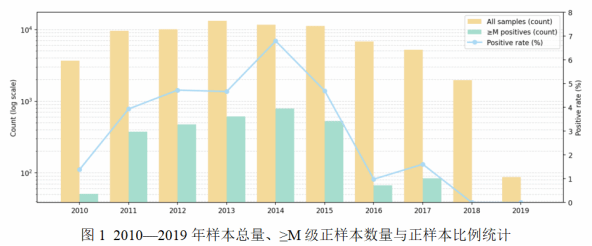
太阳耀斑是太阳大气局域区域内剧烈释放磁能和辐射能的爆发现象,其增强的 X 射线和极紫外辐射会影响短波通信、卫星导航、航空运行及相关关键基础设施。以 SHARP 参数为基础的数据驱动方法已成为太阳耀斑预报的重要技术路线,但如图 1 所示,该任务长期面临两大困难:一是 ≥M 级耀斑属于少数事件,正负样本极不均衡;二是不同年份活动区性质、耀斑率和磁场参数统计特征差异明显。
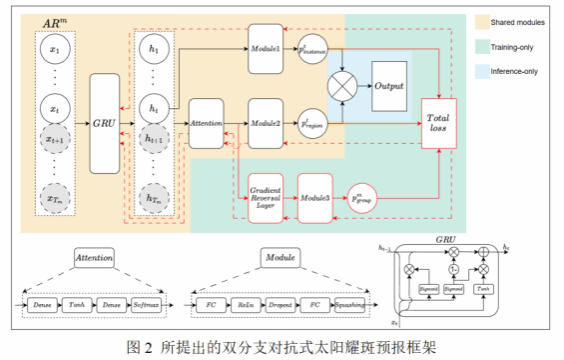
针对上述问题,研究团队提出了一种由SHARP 参数驱动的双分支对抗框架。如图 2所示,模型首先利用 GRU 对活动区的多变量时间序列进行编码,再通过attention pooling 生成活动区层面的全局表征。在预测层面,框架同时保留时间步级别的 instance branch 和活动区级别的 region branch,两条分支在推理阶段通过 soft-gating 进行概率融合,以抑制离散尖峰引起的误报,同时保持对少数耀斑样本的敏感性。除双分支设计外,研究还将梯度反转层(GRL)引入训练过程,对不同年份块进行对抗式约束,促使模型学习对太阳活动周变化更稳健的共享特征。
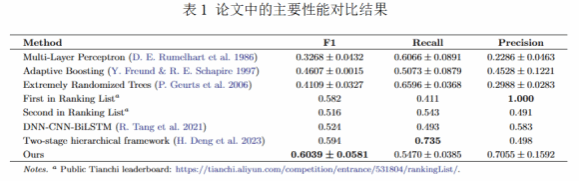
如表 1 所示,实验结果表明,所提方法在 2016—2019 时间前推测试集上取得了 0.6039 ± 0.0581 的 F1 分数、0.5470 ± 0.0385 的 Recall 和 0.7055 ± 0.1592 的 Precision,在综合平衡性上优于多种传统机器学习、深度学习模型及公开榜单方法。为空间天气智能预警提供了可推广的技术参考。
近年来,本团队持续推进空间天气等交叉领域的研究探索,为本科生参与人工智能理论及交叉应用研究提供了良好平台。
英文摘要
Solar-flare forecasting is critical in space physics, as accurate predictions mitigate space weather risks to critical infrastructure. Data-driven methods based on Space-weather HMI Active Region Patch (SHARP) parameters are mainstream but constrained by class imbalance from rare flare events, addressed herein via a dual-branch prediction structure with fused instance- and region-level probabilistic outputs to enhance sensitivity to rare samples. Beyond this, temporal distribution shift—driven by the 11-year solar cycle—is the primary bottleneck for model generalization. The 2010–2019 period (full Solar Cycle 24) exhibits significant year-by-year variations in active-region properties and flare rates, causing inconsistent cross-period data distributions and degraded performance. A dual-branch adversarial framework integrated with a gradient reversal layer (GRL) is proposed to force domain-invariant feature learning, effectively mitigating distribution shift and improving generalization. Trained on 2010–2015 data and evaluated on 2016–2019 data, the framework achieves an average F1 score of 0.604 ± 0.058, verifying its effectiveness in addressing both challenges and practical potential for solar-flare forecasting.

