近日,团队关于行星际日冕物质抛射(ICME)检测的研究成果《Tackling Distribution Drift in ICME Detection: Online Decision Calibration via Dynamic Thresholds》被天文学期刊《Publications of the Astronomical Society of the Pacific》接收。
ICME自动识别对事件目录构建和空间天气研究具有重要意义,但观测数据分布随时间变化,固定阈值检测方法适应性不足。针对这一问题,研究聚焦分布漂移下的决策层适应问题,提出了一种在线决策校准方法。该方法借鉴强自适应在线共形预测思路,设计分块更新的在线决策校准层,在不更新已训练骨干模型参数的前提下,于每个观测块到来前确定检测阈值,并根据随后获得的标签反馈在线更新阈值,实现决策层的动态适应。研究将该校准层与LSTM、CNN–LSTM、U-net和RU-net四种骨干网络结合,在统一数据划分和事件评价规则下系统比较静态与在线决策。
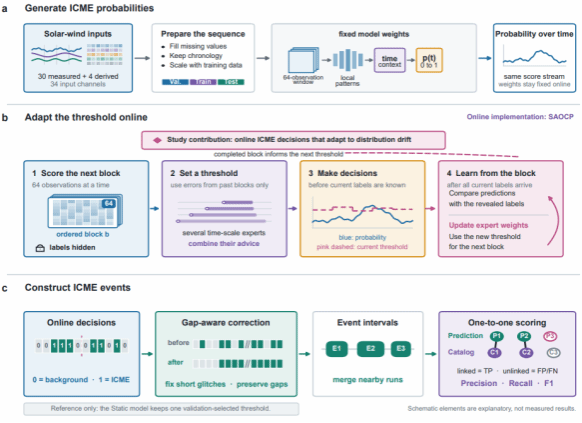
图. 算法流程图
基于Wind航天器太阳风观测数据,研究在2010—2015年、包含230个目录事件的测试区间开展评估。在线校准使四种骨干网络的事件级F1分数提高0.028—0.173,校准后达0.687—0.755;其中CNN–LSTM由0.5679升至0.7407。结果表明,即使不更新骨干模型参数,仅通过在线调整决策阈值即可改善事件识别表现。
本项工作是前期发表于ApJS 22、ApJS 25两项工作的延伸,2024级本科生雷济华为第一作者,邓昊老师为通讯作者。
标题:
Tackling Distribution Drift in ICME Detection: Online Decision Calibration via Dynamic Thresholds
摘要:
Reliable identification of interplanetary coronal mass ejections (ICMEs) from in situ solar-wind measurements is complicated by heterogeneous signatures and temporal distribution changes. To address the static-threshold limitation in conventional ICME detection, we evaluate an online decision-calibration layer that adapts the threshold of a frozen sequence detector. The layer is implemented as a blockwise expert mixture inspired by strongly adaptive online conformal prediction (SAOCP): it sets a threshold before each 64-observation block and updates only after that block’s labels are revealed. The models use 34 stored Wind features, of which 33 are nonconstant; a cross-period diagnostic found significant distribution differences for 33 features after multiple-testing correction. Training, validation-based selection, and event construction were locked before scripted evaluation on the 2010–2015 test interval containing 230 catalog events. Under one-to-one event matching, online calibration improved F1 for all four frozen backbones by 0.028–0.173, yielding online scores of 0.687–0.755. Controlled CNN–LSTM ablations show inconsistent performance gains from magnetic pressure features. The preferred sequence length depended on the decision rule; 64 observations were retained only as the reference setting. These retrospective, single-seed results support online threshold calibration as a proof of concept, but neither improvement, formal conformal coverage, nor operational readiness is guaranteed.

